
For example, characterisation is a key part of the horror genre, as it gives the audience, let's say, some backstory into the murderer's reasoning for murdering people. However, some movies go further as to emulate certain traits into the main antagonist. This can mostly be seen in the slasher genre, where film series like Friday the 13th, A Nightmare on Elm Street, the Texas Chainsaw Massacre and Halloween use this form of portrayal.
 |
 |
Another example of a character that could represent neglect is the infamous Michael Myers from the Halloween series, as it is expolained in the 2007 remake by Rob Zombie that Myers had a terrible upbringing, which causes him to become homicidal. However, I believe that this can only be believed with the remake and it's sequel, as these sequels are not really on the same wavelength as the original movies, featuring changes to the plot and characters which are substantial enough to warrant them a seperate franchise entirely.
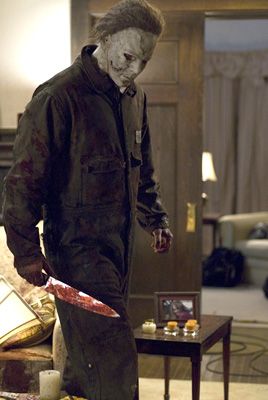 |
So, to talk about the original interpretation of Michael Myers, John Carpenter has often described the character as "almost a supernatural force - a force of nature", "a force of nature. An evil that's loose" and "a force that is unkillable." These comments lead me to speculate that the charcter of Michael Myers is meant to represent evil, which can be seen in the movie right from the beginning when a young Myers kills his older sister and then stalks his long removed sister, Laurie Strode throughout the remainder of the movie to kill her.
It could also be said that Michael represents sexual frustration as well. This can be seen through the fact that most of the people that Michael kills throughout the movies he's been in are women, which could reveal to be some sort of sexual deviance on the characters part. David Farrands, the writer of the sixth Halloween film theorized that Michael became fixated on the death of his sister, and felt the need to replicate the need to kill in Laurie Strode, whos sister-esque figure excited him sexually.

No comments:
Post a Comment